Development of VRV for Replacement Use
In the late 1990's, air conditioning refrigerant shifted from R22 to R410a to
protect the environment because R410a had a lower environmental impact than R22.
The advance of air conditioners with low environmental impact matched the time
VRV air conditioners using R22, which had been adopted 15 years earlier, were
entering their replacement period. However, because of the large-scale
installation involved, the shift did not go smoothly because of the required
expense and time.
Seeing this, Daikin designed a method for reusing the existing piping by
utilizing a thermally-driven secondary refrigeration system and filtering out
Impurities in the refrigerant. This significantly reduced the man hours needed
for replacing the VRV multi-split systems. Today Daikin has made further
advancements and developed a system that automatically performs all steps from
refrigerant charging to system testing. As a result, Daikin has achieved even
greater reduction in labor hours needed for installation. Daikin's development
greatly promotes the shift to new refrigerants and contributes to a lower
environmental impact.
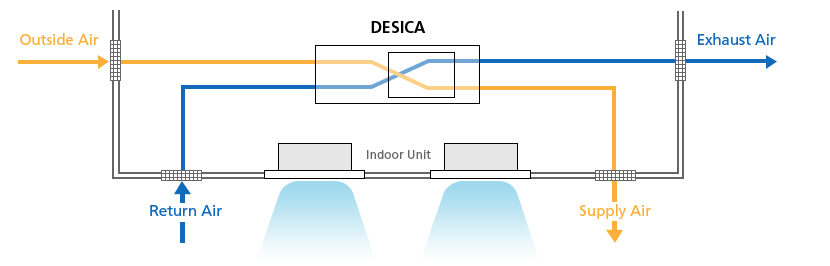
Development of the DESICA
Conventionally, controlling humidity required a large amount of energy for
reheating. For this reason, Daikin developed an air conditioning system with an
individually treatment for latent and sensible heat, and this significantly
reduced the air conditioner's work by removing latent heat. Using the heat pump
as heat source, DESICA employs a heat pump desiccant method to efficiently
adsorb and release moisture into the air. Because humidification and
dehumidification are performed without supply and drain piping, this
revolutionary system saves installation piping and the owner does not need to
care for water quality.
 What Daikin created was an ultimately new type of air conditioning.
Today, it has become one of the two types of air conditioning systems, ducted and ductless, in the world.
Daikin will always be the pioneer of air conditioning and continue to expand this new standard, from building to building, around the world.